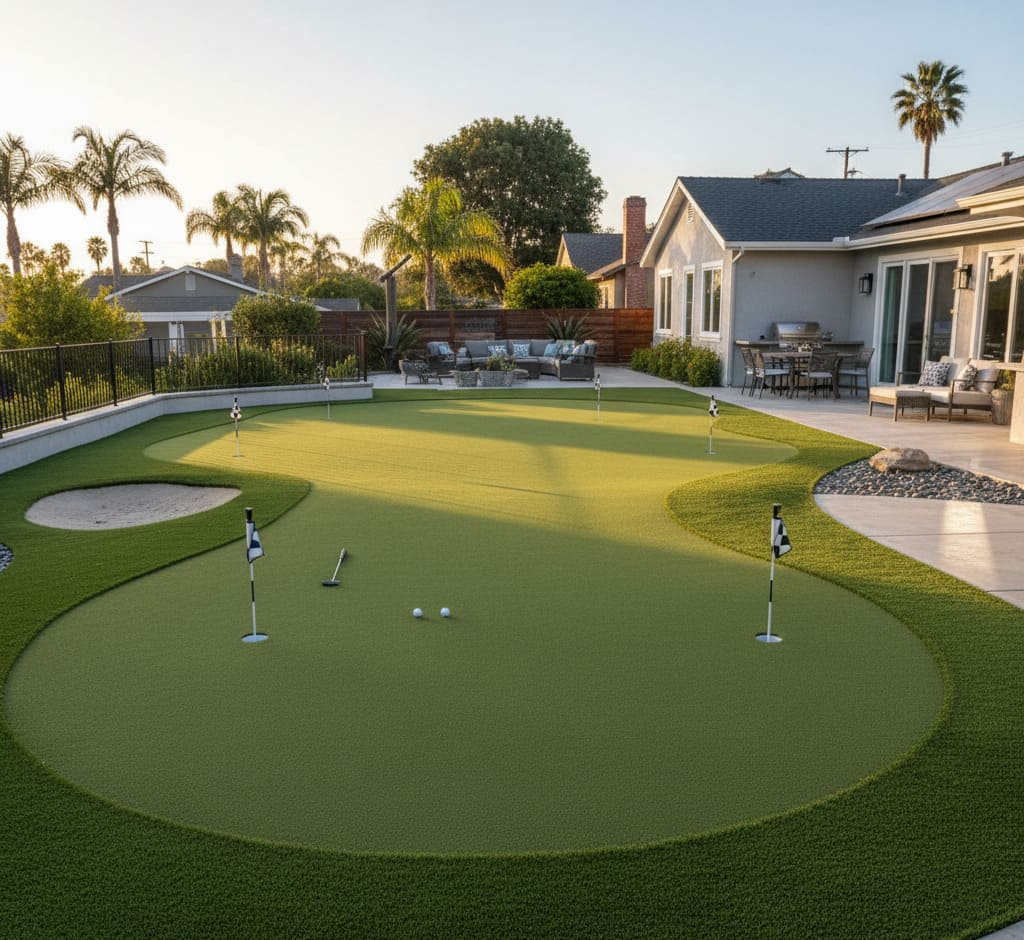
For the Long Beach golf enthusiast, the dream is to practice their short game with tour quality consistency any time they want. Many consider building a natural grass green, but this is a project that GAGA US Construction strongly advises against.
As a university extension paper on the subject bluntly states, a natural grass putting green is labor-intensive and expensive. It requires specialized equipment and frequent mowings (4–6 times weekly). Their official expert advice is not to build one.
This is the prosumer dilemma: you desire professional-grade performance but cannot provide the full-time maintenance. A synthetic putting green is the only solution. It is engineered to provide the true ball roll, consistency, and customizable speed of a professional green without the impossible maintenance.
The Turf Decision: Nylon vs. Polyethylene (PE)
The single most important material choice for your green is the turf fiber. This decision affects ball roll, durability, and cost.
- Nylon: This is the performance-first choice. Nylon is a stiffer, more resilient material. It has a higher melt temperature, making it extremely durable for high traffic and the intense heat of a Long Beach backyard. It is known for offering the most realistic, consistent ball roll. The trade-off is a higher upfront cost.
- Polyethylene (PE) / Polypropylene (PP): This is the feel-first or budget-conscious choice. Polypropylene is a budget option that often requires heavy sand infill. Modern Polyethylene (PE) has largely replaced it and is the go-to choice for most home greens. These fibers are softer and more cost-effective but are less durable than nylon.
The Expert Insight: Pile Height and Density Matter More
A common mistake is to focus only on the material. At GAGA US Construction, we find that pile height and density are more important. A high-performance green should have a short ~1/2” pile height and a high stitch count (density).
Here is a physical test you can perform on samples: when checking samples, if you can easily see the backing or gaps between fibers, it’s probably not dense enough for a good putting surface. A dense, high-quality PE turf will outperform a sparse, low-quality Nylon turf every time.
Controlling the Game: A Guide to Customizing Stimp Speed
A key feature of a synthetic putting green is the ability to customize the ball speed, or Stimp speed. This is measured with a stimpmeter. Typical ranges are 9–11 for home greens and 10–13+ for pro-level greens.
There is significant confusion about how speed is controlled. Some sources claim infill doesn’t determine speed, while others claim it does.
As installation experts, we can resolve this. Controlling speed is a 3-step process:
- Phase 1: Turf Selection (Design):
This sets the potential speed range. A dense, short-pile nylon is inherently fast and designed for high Stimp ratings. - Phase 2: Infill Amount (Installation):
This fine-tunes the speed. More infill, or a heavier, more rounded silica sand, adds friction and slows the green down. - Phase 3: Grooming (Maintenance):
This makes daily adjustments.
Rolling the green flattens the fibers and speeds up the roll.
Brushing against the grain stands fibers up and slows the roll.
The Anatomy of an Installation and the Putting Green Turf Installation Cost
A putting green’s performance is built from the ground up. This is not a simple turf installation; it is a hardscape project. A professional green requires a significantly more robust base than a lawn: a gravel base of 2 to 4 inches topped with a 6 to 8-inch compacted aggregate layer. This extensive base allows true ball roll and custom contours.
The putting green turf installation cost in Southern California is typically $20 to $35 per square foot. Other estimates range from $15 to $40, but $20–$35 is the most common range for a professional-grade green.
Understanding Your Quote (The E-E-A-T Details)
To set an honest budget, homeowners must understand two key factors that influence pricing:
- Tiered Pricing:
Smaller greens are more expensive per square foot.
Under 400 sq. ft.: $30–$35/sq. ft.
Larger 2,000+ sq. ft. greens: $20–$25/sq. ft. - Hidden Costs:
The base price typically does not include site preparation.
Difficult access or added features (tee boxes, sand bunkers) increase the total cost.
A backyard putting green is a serious investment in your home and your game. Its performance depends entirely on expert design and installation of the base, turf, and infill system.
While the putting green turf installation cost is higher than a standard lawn, the fake grass cost vs savings in water and maintenance still provides a clear long-term return on investment.